500 NEW MARIJUANA SEEDS RELEASED

Understanding the Meaning of Sativa Dominant Hybrid

The cannabis sector possesses Hybrid marijuana seeds, leading to diverse cannabis plants with distinct physical features and effects derived from regular strains such as Indica, Sativa, and Hybrids. A notable outcome of extensive scientific investigation is the Sativa dominant Hybrid marijuana seeds, which essentially remains a cannabis plant with the predominant characteristics of a Sativa strain. For those unfamiliar with cannabis cultivation, this concept may appear perplexing, but a further elaboration on Sativa dominant Hybrid marijuana seeds will be provided to alleviate any confusion.

Intro to Sativa Strains

Before delving further into the concept of a Sativa-dominant Hybrid, let’s explore the characteristics of the two strains it comprises: Sativa and Hybrid marijuana seeds.

Sativa strains are renowned for their ability to provide uplifting effects. If you are seeking a cannabis strain that can boost your energy levels and enhance your focus, Sativa might be your ideal choice. It challenges the common stereotype associated with cannabis, dispelling that it solely induces a stoned and idle state.

Sativa strains have the potential to induce mental exhilaration and offer a more elevated experience compared to other strains. They are particularly well-suited for social situations, sparking conversations, and engaging in creative endeavors. Sativa strains are also often referred to as the quintessential “wake and bake” option, making them perfect for individuals who wish to begin their day with a cannabis smoking session.

Regarding physical characteristics, Sativa plants grow tall and possess narrow leaves. They also have longer flowering cycles compared to other strains. Furthermore, Sativa strains thrive in warm climates with extended summer seasons, as these conditions favor their growth and development.

Intro to Hybrid Strains

Hybrid marijuana seeds strains are widely regarded as the pinnacle of cannabis varieties, offering a harmonious blend of both Sativa and Indica characteristics. In fact, most strains available in the cannabis market today are Hybrids, resulting from the careful crossbreeding of Sativa and Indica plants.

One of the remarkable qualities of Hybrids is their ability to inherit traits from both parent cannabis plants. This unique combination results in a more balanced experience, avoiding the extremes of a purely body or head high. Cultivators often classify Hybrids as either Sativa-dominant or Indica-dominant, Indicating which attribute of the plant is more pronounced.

Sativa-dominant Hybrids tend to produce a cerebral high, stimulating the mind and enhancing creativity. These strains are often favored for social gatherings and daytime use, promoting a more energetic and uplifting experience.

On the other hand, Indica-dominant Hybrids tend to offer a more relaxing and soothing effect. These strains are renowned for their ability to induce a sense of calm, and relaxation, and even promote sleep. They have often sought after for their potential therapeutic benefits and are popular among individuals looking to unwind and alleviate stress or pain.

The beauty of Hybrid strains lies in their versatility, as they allow individuals to tailor their cannabis experience to their desired effects. Whether seeking an invigorating cerebral high or a soothing and tranquil experience, Hybrids offer various options to cater to individual preferences and needs.

What does it mean for a Hybrid to be Sativa-dominant?

The Sativa-dominant strain of marijuana is created by crossbreeding Sativa and Indica cannabis varieties, with the resulting Hybrid leaning more towards the Sativa side. This particular Hybrid showcases its Sativa dominance in both its growth pattern and the effects it produces for cannabis users.

When referring to a pure Sativa strain, it signifies that it exhibits no Indica characteristics and originates from two parent plants that are both of the Sativa strain. These Sativa-dominant strains have gained significant popularity due to their ability to induce a cerebral, head-high experience in consumers. Moreover, they are commonly prescribed medicinally as a treatment for depression.

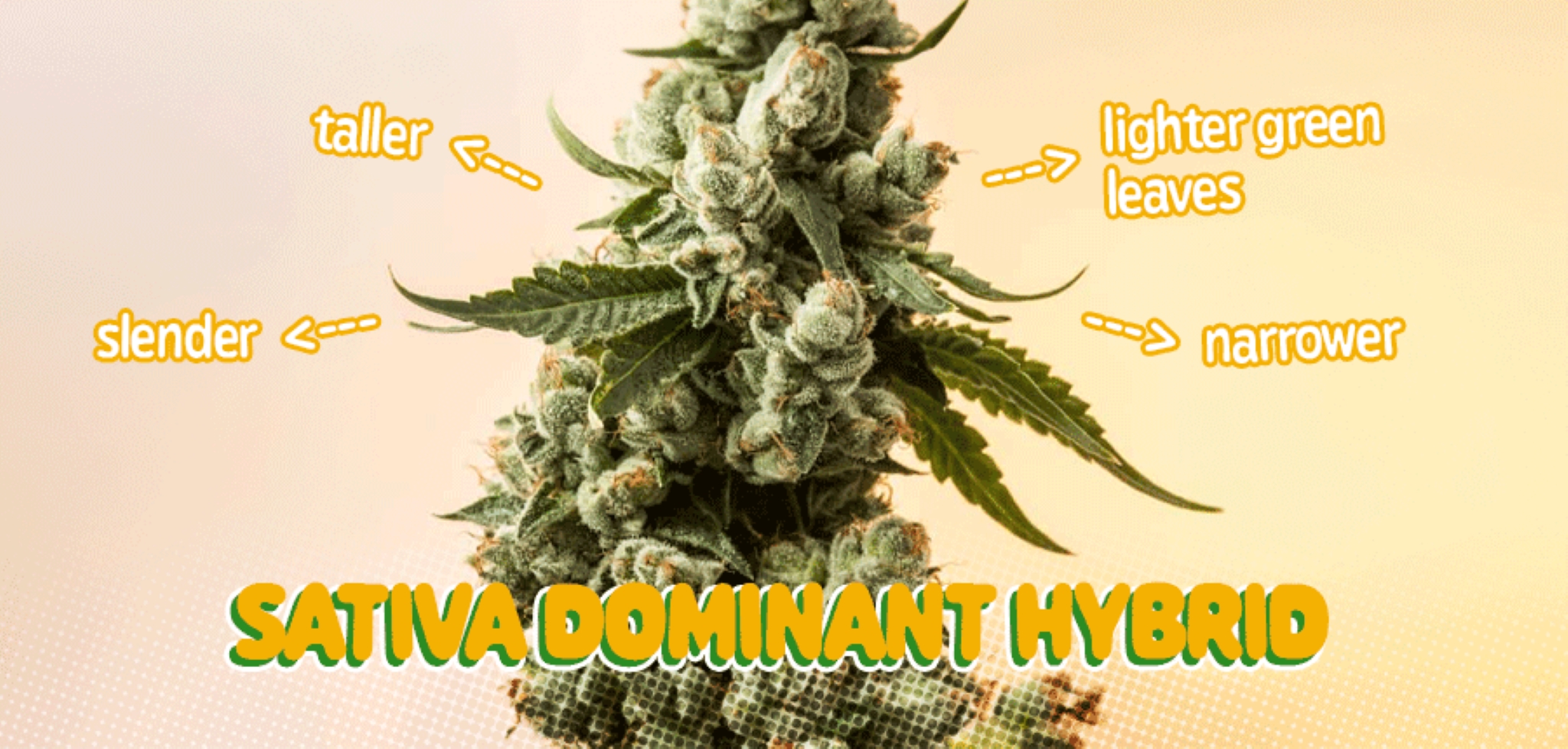
In terms of physical characteristics, Sativa-dominant strains differ from their Indica-dominant counterparts. They tend to be taller and more slender, accompanied by narrower and lighter green leaves. Pure Sativa plants can reach impressive heights, growing up to 20-25 feet tall or roughly 6-7.6 meters. Consequently, if you have a Sativa-dominant cannabis plant, you can expect it to exhibit similar tall growth tendencies as its pure Sativa ancestors.

Sativa-dominant strains thrive in growing outdoor environments but can also flourish in a well-maintained greenhouse. These varieties are particularly well-suited for cultivation in warm weather regions or countries near the equator, where the climate favors their growth and development.

Like the original Sativa species, Sativa-dominant Hybrids are often preferred for daytime consumption. Unlike Indica strains, they do not induce feelings of fatigue or lethargy. Users have reported enhanced clarity of thought and increased focus under the influence of Sativa-dominant strains.

While it is not a universal rule, many Sativa-dominant strains are characterized by including “haze” in their names. This naming convention is commonly associated with these types of Hybrids. Some of the most renowned Sativa-dominant strains worldwide include Purple Haze, Juicy Fruit, Strawberry Cough, J1, and Trinity.

Understanding Which Cannabis Variety Is Suitable for Your Needs

Every cannabis consumer has unique preferences when it comes to the type of weed they choose to consume. Some individuals prefer to smoke Sativa strains throughout the day, while others lean towards Indicas for winding down and relaxation, especially after a long and tiring day.

If you’re curious about which cannabis strain is right for you, the first step is to consider your intended use. If you plan on growing your cannabis, it’s essential to take into account the specific growing requirements, the duration of cultivation from germination to harvest, and the expected yield of the plant.

On the other hand, if you’re looking to ingest cannabis for its effects, you need to ask yourself what kind of experience you’re seeking. Do you need mental stimulation, hoping to tap into your creative side, and seeking motivation to accomplish tasks? In that case, Sativa or Sativa-dominant Hybrids would be suitable choices.

However, if you’re aiming for a relaxing sensation after a stressful day, assistance with sleep, or simply desiring to unwind on the couch while enjoying a good movie, Indica or Indica-dominant Hybrids are your best bet.

Before committing to a particular strain for long-term consumption or cultivation, testing different strains is advisable. Visit local dispensaries or seed banks and purchase small amounts of Indica, Sativa, and Hybrid strains. Typically, the smallest available size is 1 gram.

For those new to cannabis ingestion, it’s recommended to schedule strain testing on days when you have no obligations or responsibilities, such as your day off. You wouldn’t want to consume a Sativa-dominant strain before heading to work, as it may cause overwhelming energy, which could be noticeable to your colleagues.

Are In Bred Lines of Cannabis Attainable Through Hybridizing?

As a novice breeder, you may feel nervous and uncertain about the outcome of your prime cannabis project. This is normal. All breeders experienced that same anxiety and hesitation in their first grow. Do you have a strain to cross in mind? Are you going for hybrids? Or do you want an inbred offspring? These are the usual questions you should have an answer to before you start hybridizing cannabis. If you are ambiguous still on these things, then you must continue reading this article to help shed some light on the darkness that secludes you.

Breeding and A Long Cannabis History

· Cannabis was the first plant used in the making of fiber for paper and ropes as early as 8000 BCE.

· Canvas was made from cannabis. The word canvas came from the Greek term kannabis and Latin word cannabis.

· Emperor Shen Nung, the Father of Chinese medicine, described marijuana as one of the dominant plants in Chinese medicine as early as 2700 BCE in Chinese history.

· In 1865, Gregor Johann Mendel, an Austrian scientist, began his well-known pea hybridizing cannabis experiments that gave us the basic rules of inheritance (now termed as the laws of Mendelian inheritance). It was through his observations of how certain traits seemed to surface and go through the generations that he concluded some genes must be dominant and others recessive.

· By the middle of the 19th century, most cannabis species were legal almost everywhere in the world, aside from a few Islamic countries.

· In the 1960s, wild landrace sativas began showing up in the United States. Seeds were being grown in greenhouses in southern and central California.

· The 1970s came, and little-known indica sub-species were introduced and soon revolutionized the indoor grow the scene.

· In the 1980s or the “Golden age of breeding,” the West Coast exploded with the cornerstones to almost every strain we breed today. The most popular of these strains include Northern Lights, Hash Plant, Skunk #1, and Big Bud.

· In the middle of the 20th century, hybridizing Cannabis divided into strains producing fiber, seeds, and drugs.

· Cultivars meant for making drugs were forbidden, mocked, and labeled as marijuana – a term that originated from the language of a native Mexican ethnic group.

· Bypassing laws and punishments, the cultivation of psychoactive (high THC) cannabis strains was carried out by stealth to match the high underground demand.

· By the end of the 20th century, cannabis laws were loosened, and the open planting, cultivation, and creation of new strains started. The Netherlands was the first nation to legalize cannabis. In 2015, Uruguay first legalized recreational marijuana, and Canada followed suit in 2018.

A little bit of cannabis history helps you understand the importance it played so many years ago and the part it still plays until now. So, next, we define the word breeding.

What is Breeding?

Breeding is used as a noun that means “a process of combining plants to produce targeted traits.” Breeding purifies and strengthens a strain. A backbone of the cannabis industry, most growers experiment and become breeders to achieve a strain perfect for their needs.

The Mechanics of Plant Reproduction

Cannabis has two chromosomes or a diploid genome, one from the mother strain and another from the father strain. When you breed, you take a male and female plant to cross with each other allowing each to contribute its genes to the child strain.

A copy of each parent plant’s chromosome is supplied by the plant’s sex cell, which is ovule in the female and pollen in the male plants. During reproduction, these cells join together, mixing the two genes in a process called recombination.

Recombination allows the genetic material to become congregated in one area on the chromosome, making the selection and removal of traits easier. This makes it less troublesome to cultivate a strain of its highest potential and a better adapted one.

Cannabis can be reproduced asexually or sexually. Asexual reproduction uses the same plant to be produced again and again. Sexual reproduction involves crossing different parents. There are also vegetative methods that include cutting, cloning, and even division of roots.

To which strain you are to reproduce really depends on what characteristics (size, autoflowering or not, resin quality, terpenes, yields, color, effects, resilience, THC, and CBD levels and resistance), what species and type of breeding you opt to select. You may choose from an indica, sativa, or ruderalis. Indicas are short and bushy plants. Sativas are tall and tree-like, while ruderalis are autoflowering strains. Mix and match any two or three strains as inbreds or hybrids. Here is a quick rundown on the 2 types of breeding.

Two Types of Breeding: Inbred Lines vs. Hybrid Lines

Inbred Lines or IBL-

Breeding of a mother to son and daughter to father, a transfer from generation to generation from the same family to ensure that a stable trait of marijuana will be produced and show little variations on their phenotypes. It simply is the act of crossing a group, variety, or family of plants with each other. The offspring cannabis from inbreeding is considered an inbred line. It takes lots of time, patience, and hard work to achieve inbred lines. These are paid off with good results of having healthy uniform plants that tend to produce consistent offspring. A good example is Skunks. They were hybridized, and after many generations, they developed into the Cheese family. Other examples of inbred lines are Blueberry, Columbian Gold, and Thai.

An extreme form of inbreeding, “selfing,” happens when a plant pollinates itself, producing a new strain with the same genetics. This results in “stale genetics” or “inbreeding depression,” where the lineages produced become less vigorous over time. This can surface as a reduction in potency or a decrease in yield or rate of growth. To deal with this dilemma, breeders would often hybridize or out-cross the plant to restore health once inbred depression show.

Anyhow, here are some signs that would help you determine when a line is becoming too closely inbred:

It becomes more prone to disease.
Exhibit new colors from what is expected of it. From a generation of dark greens, a lighter shade of green may appear along the way.
Abnormalities or simple undesirable traits may surface through the generations.

Hybrid Lines

When you recombination vastly different genetic information by crossing a true inbred line with another strain from a different family or from a distant relation, then a hybrid line is produced. This improves hybrid vigor that increases genetic diversity and the health of the lineage. Tangie is one of the famed and loved hybrids. Created between a cross of Cali-O and Skunk by Crockett Family Farms, this strain is widely sold in the online market. A wide variety of phenotypic traits, such as varying heights and leaf shapes are noted from one bag of seeds that all share the same Tangie genotype. Despite their peculiarities, the characteristic tangerine aroma will be the same for all of these plants.

A man-made attempt at customizing cannabis with characteristics of different species, here are 5 kinds of hybrid strains that can result from your crosses:

1. An Indica plus indica: Two different indica varieties are crossed together.

2. A Sativa plus sativa: Two different sativa varieties are combined together.

3. An Indica plus sativa: This variety will have characteristics of both, but is more potent on the indica side. It may result in a short plant with light-colored buds.

4. A Sativa plus indica: A hybrid strain with dominant characteristics of a sativa . However, it has traits of both varieties of cannabis. It could be a tall and lanky plant with resinous buds, for example.

5. Autoflowering hybrids are strains that have been mixed down the generation with ruderalis genetics.

Hybridizing In Bred Lines Simplified

Are you ready with answers to the questions we had earlier? Have you picked a female and male strain for breeding? Did you carefully choose characteristics you want to flourish in your plant? Are you going to breed two strains from different groups? Or do you want to strengthen your plant’s traits through inbred lines?

Still having a hard time? Life can be easy once everything is simplified. Let’s summarize what we have learned. Breeding cannabis involves choosing the best female and male plant for pollination. You should know what characteristics you want to boost in your strain. Take note of a strain’s color, smell, amount of yield, auto-flowering or not, CBD level, and the cerebral and physical effects it gives, etc. Once decided, choose from inbred or hybrid breeding. Hybrids, usually a mix of indica, sativa, or ruderalis, bring about diversity in the plant’s genetics through time. If you want to go for stability in your plant’s traits, inbred lines are perfect. Just remember not to overdo it too much as it losses vigor along the way.

That was smooth sailing, wasn’t it? From here, you can go ahead and turn that anxiety into excitement. Start your garden with inbred lines and hybrids that are easily attainable through hybridizing.